
Immunomodulators are rewriting the rules of immune control. But how do they actually work? The mechanisms behind these agents could flip the switch between illness and resilience.
When Balance Breaks, Immunomodulators Step In
Every single day, your body is engaged in an invisible battle. Viruses are attempting to break in, bacteria are trying to establish outposts, and sometimes your own cells mutate and become a threat. Yet most of the time, you don’t notice anything happening at all.
This remarkable silence is due to your immune system, a sophisticated network of cells and molecules working in perfect coordination. But what happens when this system starts to slow down or work inefficiently? This is where immunomodulators come into play.
What are immunomodulators? They are biologically active substances that can adjust, enhance, or suppress the immune system’s activity to help your body maintain balance and fight diseases more effectively.
There are several types of immunomodulators, including both natural and synthetic compounds. Scientists classify them according to their origin, chemical structure, and the part of the immune system they influence. For a clear definition, classification, and examples, visit our main article Immunomodulators: Natural Allies of Our Immune System.
How Does the Immune System Work?
To understand how immunomodulators work, you first need to grasp how your immune system operates. Think of it as two distinct security systems working in parallel, each with different strengths and response times.
Innate immunity is the body’s first defence against infections and threats. It uses various types of white blood cells such as macrophages, dendritic cells, natural killer cells, and other innate lymphoid cells to quickly recognise and attack invaders[1].
| How innate immunity works: Natural killer (NK) cells patrol your bloodstream, looking for infected cells or cancer cells. Upon recognising a threat, NK cells release signalling molecules called cytokines, which help coordinate the immune response and activate other components of immunity. Macrophages consume pathogens and debris, neutrophils rush to the site of infection to destroy microbes, while specialised dendritic cells sample the environment and look for danger. |
Adaptive immunity is slower, but provides highly specific and long-lasting protection. This system requires training and education. It relies on specialised cells called B cells and T cells, which recognise unique features (antigens) of pathogens and remember them for faster responses in the future[2].
| How adaptive immunity works: When a novel pathogen appears, special cells called dendritic cells notice it, and alert other parts of the immune system, especially T cells. These cells then become activated, multiply, and coordinate the immune response. B cells also join in and make antibodies that specifically recognise and neutralize the pathogen. After the infection is cleared, some T and B cells remain as memory cells, allowing the immune system to respond more rapidly if the same threat comes back. |
| Feature | Innate Immunity | Adaptive Immunity |
| Response speed | Immediate, non-specific | Slower, develops after exposure |
| Main cells involved | Macrophages, dendritic cells, natural killer cells, neutrophils | T cells, B cells |
| Specificity | Recognises general patterns of pathogens | Targets specific antigens |
| Memory | No immune memory | Develops long-lasting memory cells |
| Main function | First line of defence; rapid attack on invaders | Precise, targeted response; improved defence upon re-exposure |
| Interaction | Provides signals and information to activate adaptive immunity | Relies on signals from innate immunity to start response |
Table: Main characteristics of the innate and adaptive immune systems.
The two systems work together seamlessly. Innate immunity provides an immediate response, while also gathering intelligence about the threat. This intelligence gets passed to adaptive immunity, which then generates a targeted, long-lasting response.
And what role do immunomodulators play in this complex story? Some modulate innate immunity, others affect adaptive immunity, and a few can influence both systems at once. They do so by targeting different immune cells and signalling pathways within each system.
What Is the Mechanism of Action of Immunomodulators?
Your immune cells don’t simply react to danger. They communicate through a sophisticated molecular language. Immunomodulators work by either mimicking this language or amplifying certain parts of the conversation. Their mechanisms of action are diverse and depend on the type of immunomodulator. The main modes of action are as follows[3]:
- Modulating immune cell activity – immunomodulators can either stimulate or suppress the activity of various immune cells, helping the body fight infections or cancer, or preventing overactive immune responses. For example, some natural immunomodulators affect macrophages and neutrophils, essentially giving these cells bigger appetites and better digestion.
- Affecting signalling pathways – many immunomodulators enhance the production of molecules called cytokines. Cytokines are chemical messengers that tell immune cells how to behave, either ramping up or calming down the immune response.
- Direct binding to cell surface receptors – think of receptors as mailboxes on the surface of immune cells used for communication between cells. When an immunomodulator delivers its “message” by binding to these mailboxes, it triggers a signalling cascade that can change how the immune cell reacts to future threats.
- Regulating inflammation – many immunoactive compounds help control inflammation by either increasing or decreasing the production of inflammatory molecules, which is important in treating autoimmune diseases and allergies.
- Promoting immune memory or tolerance – certain agents help the immune system remember past threats or teach it to ignore harmless substances (important in allergies, asthma and transplants).
- Directly affecting disease processes – some synthetic or natural immunomodulators can stop the growth of cancer cells (inducing apoptosis – programmed cell death), prevent blood vessel formation in tumours, or help repair tissues by influencing immune responses.
Immunomodulators can act through several mechanisms, influencing how the immune system recognises, communicates, and responds to potential threats.
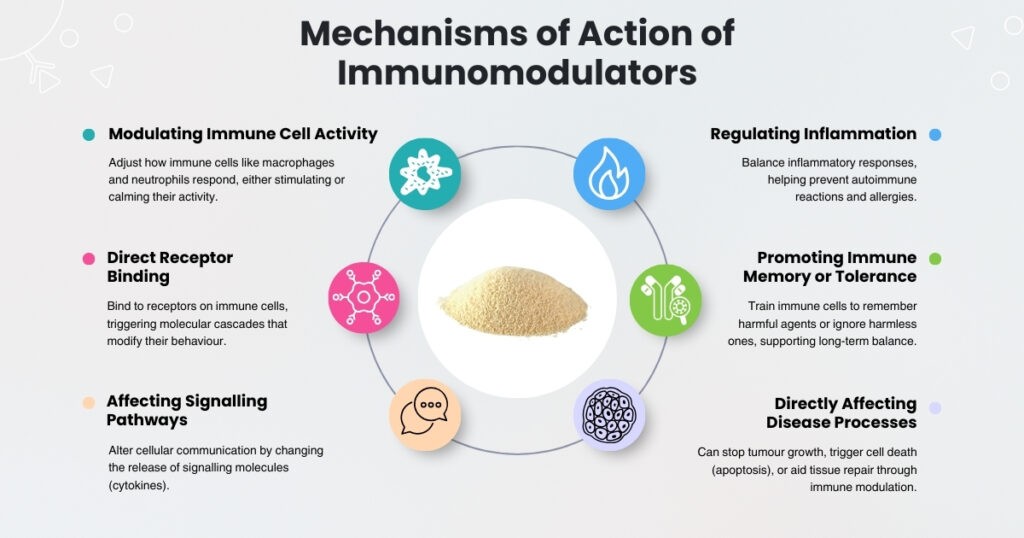
Immunomodulators can act through several mechanisms, influencing how the immune system recognises, communicates, and responds to potential threats.
Arabinoxylans: Natural Immune Enhancers
Among all the immunomodulatory compounds, arabinoxylans have attracted particular scientific attention due to their ability to modulate both innate and adaptive immune responses. These natural immune enhancers are complex polysaccharides found in the outer layers of grain brans, particularly rice bran.
Arabinoxylans exemplify how sophisticated natural immunomodulators engage multiple mechanisms simultaneously. Here’s what research tells us about arabinoxylan benefits and their mechanisms of action:
- They talk directly to immune cells. Arabinoxylans can interact with macrophages and dendritic cells in the gut, activating receptors such as Dectin-1. This helps trigger both innate and adaptive immune responses[4].
- They feed your microbiome. Acting as prebiotics, arabinoxylans serve as food for beneficial bacteria in the gut. These microbes, in turn, produce short-chain fatty acids and other metabolites that reduce inflammation and support immune balance[5].
What Is the Difference Between Arabinoxylan Fibre and Supplements? The fibre refers to the natural polysaccharide found in cereal grains that mainly acts as a prebiotic, meaning it feeds the good bacteria in your gut and helps keep your digestive system healthy[6]. On the other hand, arabinoxylan supplements (e.g. BioBran 1000) are concentrated, often enzymatically modified forms of arabinoxylans, processed to produce smaller, more bioactive fragments. These natural immune products can do more than just support gut health – they can also help regulate the immune system by directly interacting with immune cells and boosting the body’s defences. In short, while arabinoxylan fiber mainly supports gut health, arabinoxylan supplements can go a step further by also helping to fine-tune your immune response. |
What Is BioBran MGN-3 and How Does It Work?
BioBran, scientifically known as MGN-3, represents the pinnacle of modern use of arabinoxylans in medicine. It is a plant-derived immunomodulator made from rice bran that has been enzymatically modified using enzymes from shiitake mushrooms.
Research[7] shows that BioBran arabinoxylan compound can enhance both innate and adaptive immune functions, especially in older adults and high-risk populations. It works by stimulating various immune cells, including natural killer cells, dendritic cells, and T cells. This stimulation leads to an improved ability to fight against viruses, bacteria and tumour (cancer) cells. Health benefits of BioBran according to clinical studies[8-12]:
- Improves quality of life. BioBran MGN-3 has been shown to enhance both physical and mental well-being in older adults, reducing pain, increasing energy and improving social functioning.
- Strengthens immune defence. It boosts the activity of natural killer cells, dendritic cells and T cells, helping the immune system respond more effectively and reducing the risk of flu-like illnesses, especially in the elderly.
- Supports cancer therapy. When used alongside conventional treatment, BioBran may strengthen immune responses, lessen chemotherapy side effects and potentially improve survival rates.
- Protects liver and brain health. BioBran has demonstrated protective effects on the liver and may help prevent damage while supporting healthy function. Research also suggests antioxidant and anti-ageing properties that could benefit brain health, though more human studies are needed.
- Shows antiviral potential. Early findings indicate BioBran may help the body combat viral infections, including SARS-CoV-2 (the virus that causes COVID-19), by boosting immune cell activity and lowering viral load in laboratory models.
BioBran MGN-3 Arabinoxylan Compound, a nutritional supplement produced from rice bran. Available in boxes of 30 or 105 sachets, or as 50 tablets.

The Future of Immune Health and Natural Modulation
Understanding how immunomodulators work reveals a profound truth about health: sometimes the most sophisticated solutions come from sources our ancestors already valued. Rice bran has been prized in traditional medicine for centuries, while shiitake mushrooms have long been consumed and respected for their nutritional and healing properties.
Yet it has taken modern scientific tools to uncover how these traditional substances work at the molecular level. The growing body of evidence on immunomodulators shows that natural compounds can enhance multiple components of the immune system at once. Arabinoxylans and BioBran MGN-3 demonstrate how a deeper understanding of biological mechanisms can translate into practical strategies for maintaining immune health.
Frequently Asked Questions: How Immunomodulators Work
What are immunomodulators? – Immunomodulators are biologically active substances that adjust, enhance, or suppress the immune system’s activity to help the body maintain balance. Learn more about their definition, types, classification and examples in our main article Immunomodulators: Natural Allies of Our Immune System.
How do immunomodulators work? – Immunomodulators influence the immune system in several ways. They can attach to receptors on immune cells, adjust the signals that control how these cells communicate (cytokines) and help manage inflammation or immune memory. These actions coordinate how the body recognises and responds to potential threats.
What does the term ‘immunomodulator’ mean? – The true meaning of immunomodulator lies in balance rather than strength. These substances help the immune system decide when to activate or rest, maintaining harmony instead of constant stimulation.
What are arabinoxylans? – Arabinoxylans are complex polysaccharides found in cereal brans such as rice and wheat. They act as natural immune enhancers, supporting both innate and adaptive immunity through direct effects on immune cells and by nourishing beneficial gut bacteria.
What is the difference between arabinoxylan fibre and arabinoxylan supplement? – Arabinoxylan fibre naturally occurs in whole grains and acts mainly as a prebiotic. Arabinoxylan supplements, such as BioBran, are concentrated or enzymatically modified forms designed to deliver higher, more bioactive doses with direct immunomodulatory effects.
What is BioBran and how does it support immunity? – BioBran MGN-3 is a natural immune product derived from rice bran and modified with shiitake mushroom enzymes. Studies show that it boosts natural killer (NK) cell activity and overall immune defence, making it one of the best-studied arabinoxylan-based supplements for immune health.
References
- https://doi.org/10.1038/ni.3375
- https://doi.org/10.1002/mco2.714
- https://doi.org/10.1007/s44337-024-00029-3
- https://doi.org/10.1016/j.ijbiomac.2022.04.071
- https://doi.org/10.1016/j.carbpol.2015.11.068
- https://doi.org/10.3389/fmicb.2016.00979
- https://doi.org/10.3390/molecules28176313
- https://doi.org/10.1007/s11136-019-02286-7
- https://doi.org/10.1177/1534735417735379
- https://doi.org/10.1016/j.biopha.2020.110064
- https://doi.org/10.3390/nu17121993
- https://doi.org/10.3390/nu16060881
- Photo: Freepik
About the author:
Maria Piknova, PhD, is a biochemist and science blogger specialising in microbiology and molecular biology. She is passionate about translating complex science into clear, evidence-based insights. [ORCID / LinkedIn]