

Plasmalogens make up roughly 10 – 20 % of all phospholipids in the human body. When their levels fall, the consequences range from severe inherited disease in infants to subtle but measurable cognitive decline in ageing adults. Understanding why plasmalogens drop, and what can be done about it, is one of the more active frontiers in lipid research.
Quick summary
- Plasmalogens are a distinct class of membrane phospholipids, most concentrated in the brain, heart, immune cells, and sperm.
- Plasmalogen deficiency can be inherited or secondary to neurodegeneration, oxidative stress, and ageing.
- Plasmalogen supplements derived from marine sources or synthetic precursors can raise plasmalogen levels, though human evidence is still limited.
Table of Contents
What Are Plasmalogens and Why Do They Matter?
Plasmalogens are a special type of fat that forms part of every cell membrane in the human body. They make up roughly 10-20 % of all membrane phospholipids [1,2]. That makes them one of the most abundant structural components in human tissue.
What sets them apart from ordinary membrane fats is one specific chemical feature: a vinyl-ether bond at one position of their molecular backbone. That single difference changes how cell membranes behave. Plasmalogens do three things ordinary fats cannot do as well:
- They help regulate how fluid and flexible membranes are, which affects how cells communicate and respond to signals [1,3].
- They support the formation of small membrane platforms called lipid rafts, which cells use for signalling [4,5].
- They act as built-in antioxidants. Because the vinyl-ether bond is easily attacked by reactive oxygen species, plasmalogens absorb oxidative damage before it reaches more fragile molecules nearby [1,6].
When plasmalogen levels drop, all three of these functions are compromised. That is what makes deficiency clinically significant.
Where in the Body Are Plasmalogens Found?
Plasmalogens are present in all mammalian tissues, but their concentrations are highest where membranes face the greatest functional demands.
| Tissue | Notable plasmalogen content [1,2] |
| Brain and myelin | Ethanolamine plasmalogens form a large share of phosphatidylethanolamine in myelin sheaths. |
| Heart | Choline plasmalogens make up roughly 30 – 40% of choline phospholipids |
| Inflammatory white blood cells | Can reach up to ~50% of total phospholipids |
| Spermatozoa | Among the highest recorded concentrations, around 55% |
Other enriched sites include the retina, skeletal muscle, kidney, and mitochondrial membranes [7]. This distribution explains why a deficit does not produce a single, narrow symptom, but a spectrum of problems depending on which tissues are most affected.
Recommended product

How Plasmalogens Are Made: The Role of Peroxisomes
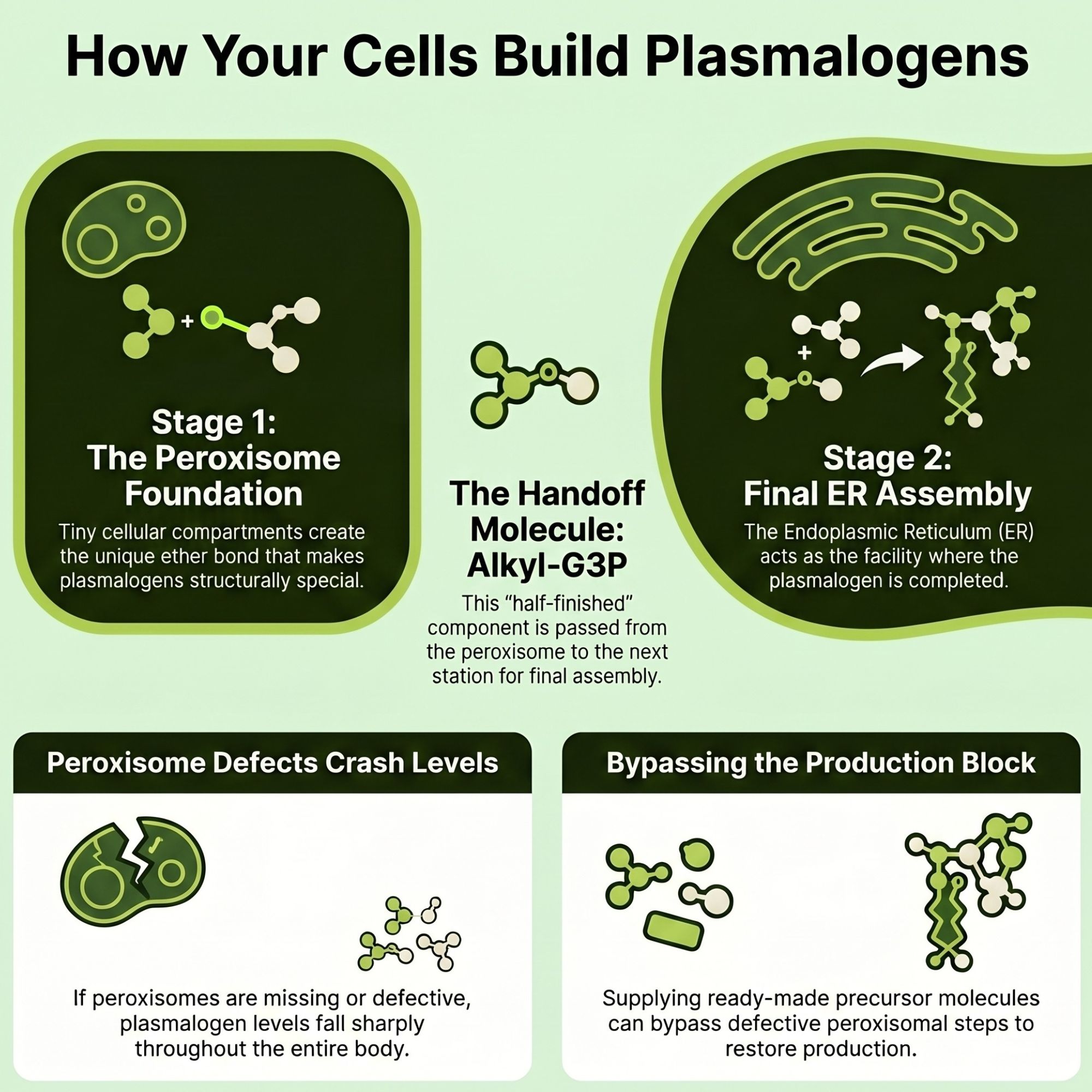
Plasmalogen synthesis pathway is a two-stage process that takes place in two different parts of the cell [8,9]:
- The first stage happens in structures called peroxisomes, tiny compartments inside cells whose job is to carry out chemical reactions that cannot safely happen elsewhere.
- The second stage is completed in a network called the endoplasmic reticulum (ER), which acts as the cell’s main production and processing facility [?]
The peroxisome handles the most critical part: creating the ether bond that makes plasmalogens structurally unique. If peroxisomes are missing or their enzymes are defective, this step cannot happen and plasmalogen levels fall sharply throughout the body [10,11].
The handoff molecule between the two compartments is called alkyl-G3P. Think of it as a half-finished component passed from the peroxisome to the ER for final assembly. In some diseases, supplying ready-made precursor molecules from outside the cell can bypass the defective peroxisomal steps and partially restore production further down the line [12,13].
What Causes Plasmalogen Deficiency and What Diseases Are Linked to It?
Plasmalogen deficiency falls into three broad categories, each with a different underlying mechanism and a different clinical picture.
Inherited disorders affecting peroxisomes
Some people are born with genetic mutations that prevent peroxisomes from working properly. Without functioning peroxisomes, the body cannot complete the first stage of plasmalogen synthesis. The result is severely reduced levels across multiple tissues from birth [11,14].
The diseases most directly linked to plasmalogen deficiency in this category are Zellweger spectrum disorders and rhizomelic chondrodysplasia punctata (RCDP). Both are diagnosed in infancy and both cause dramatically low plasmalogen levels throughout the body [15,16].
Secondary deficiency in other diseases
Oxidative stress, ageing, and lifestyle
Can Plasmalogen Levels Be Restored? What the Research Shows
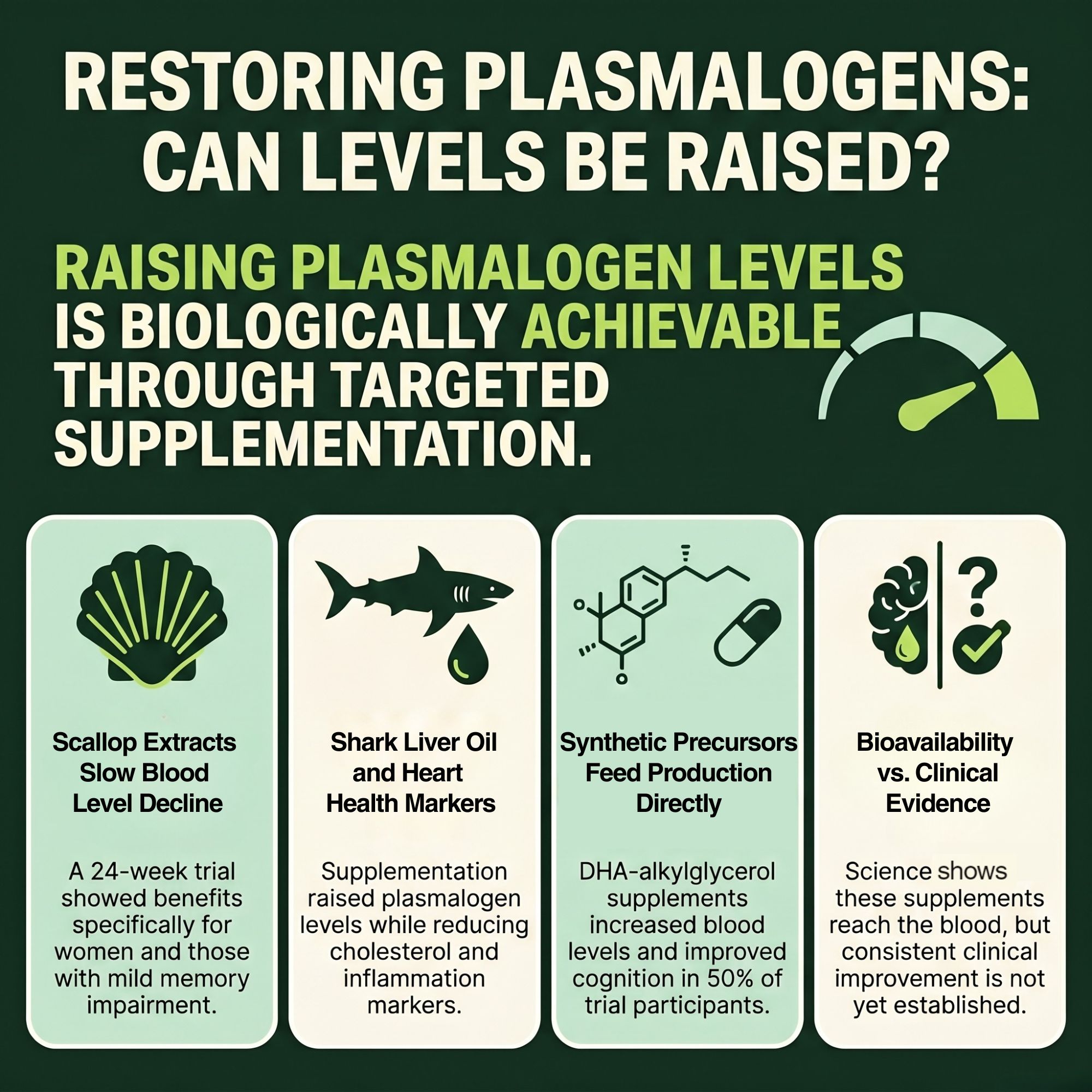
The short answer is yes, partially. Plasmalogen therapy, meaning raising plasmalogen levels through supplements or precursor molecules, is biologically possible. Several approaches have been tested in humans and animals, with promising but still early results.
Marine-derived plasmalogens
Shark liver oil and alkylglycerols
Synthetic precursors
What the evidence actually shows about plasmalogen therapy
How to Increase Plasmalogen Levels Through Diet
- Meat (beef, pork, chicken): highest total plasmalogen content among common foods
- Seafood (squid, scallops, mussels): lower total amounts, but richer in omega-3 plasmalogens
- Egg yolk: contains mainly ethanolamine plasmalogens with DHA; one egg provides approximately 0.3 mg
Key Takeaways
Plasmalogens are structurally and functionally distinct from ordinary membrane fats. Their synthesis depends on functioning peroxisomes, and any disruption to that process, whether genetic, age-related, or driven by oxidative stress, reduces a protective resource that the brain, heart, and immune system rely on.
In adults, more gradual plasmalogen loss is consistently associated with Alzheimer’s disease, Parkinson’s disease, and related conditions. Research into dietary and supplemental approaches is active and shows biological promise, but the evidence base for clinical use remains early.
Frequently Asked Questions About Plasmalogen Deficiency
What is plasmalogen deficiency?
Plasmalogen deficiency means that levels of a specific type of membrane fat called plasmalogens are lower than normal in the body’s tissues. This can be caused by inherited genetic disorders, neurodegenerative diseases, or gradual decline driven by ageing and oxidative stress.
What diseases are linked to plasmalogen deficiency?
The most directly linked conditions are Zellweger spectrum disorders and rhizomelic chondrodysplasia punctata (RCDP), both inherited diseases diagnosed in infancy. In adults, lower plasmalogen levels are consistently associated with Alzheimer’s disease and Parkinson’s disease, and emerging evidence connects them to ME/CFS and post-COVID illness as well.
What is the role of peroxisomes in plasmalogen synthesis?
Peroxisomes are small compartments inside cells responsible for the first and most critical steps of plasmalogen synthesis. If peroxisomes are missing or their enzymes carry mutations, the plasmalogen synthesis pathway cannot function and levels fall sharply throughout the body.
How to increase plasmalogen levels?
The most studied approaches include marine-derived plasmalogen supplements (typically from scallops), shark liver oil rich in plasmalogen precursors, and synthetic compounds such as DHA-alkylglycerol. Foods such as meat, seafood, and egg yolk contain plasmalogens naturally, but dietary sources alone are unlikely to correct a significant deficiency.
What is plasmalogen therapy and is it safe?
Plasmalogen therapy refers to raising plasmalogen levels using supplements (such as Cogni8) or precursor molecules. Human studies so far report no significant side effects at the doses tested. However, evidence is still limited and most trials have been small, so plasmalogen therapy is not yet an established clinical treatment.
What is cell nutrient plasmalogen treatment?
Cell nutrient plasmalogen treatment is a term used to describe nutritional supplements that supply plasmalogens or their precursors directly to cells. These include purified marine plasmalogens and alkylglycerol-based products. The goal is to support the body’s plasmalogen levels where natural production is insufficient.