
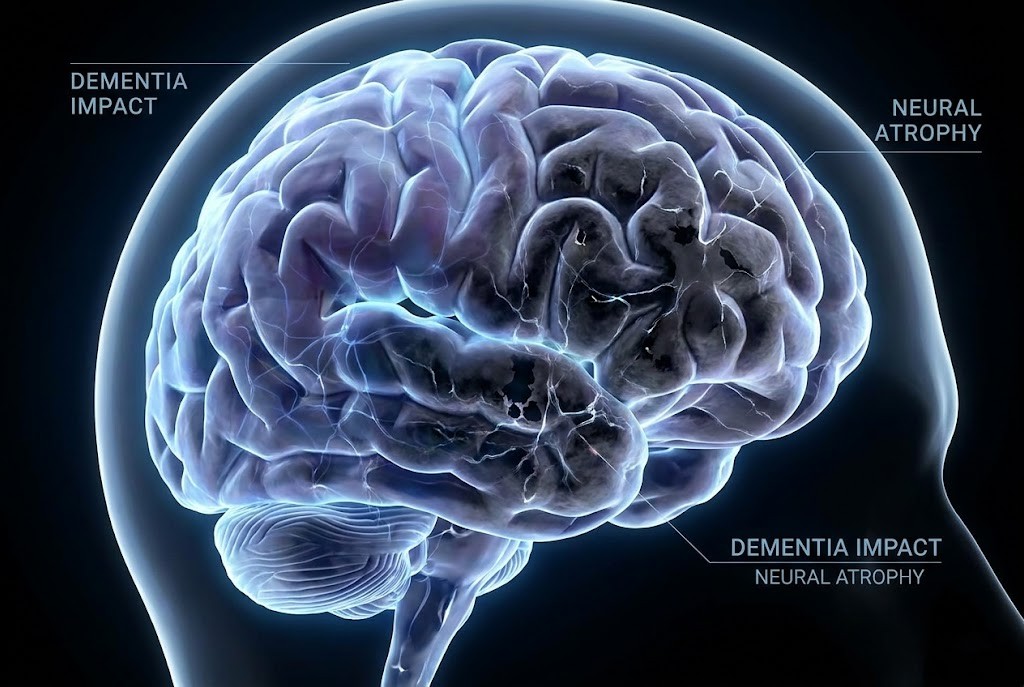
Something unusual keeps turning up in the brains of people with dementia. It is not a new protein, a viral agent, or a genetic mutation. It is the absence of something that should be there: a class of specialised membrane fats called plasmalogens. The deficit shows up consistently across postmortem brain tissue, blood samples, and large population cohorts. And in some cases, it appears years before any symptoms emerge. That is what makes the link between plasmalogens and dementia worth examining closely.
Quick summary
- Plasmalogens are specialised phospholipids abundant in the brain, concentrated in synapses and the insulating sheaths around nerve fibres.
- Blood and brain plasmalogen levels are consistently lower in people with Alzheimer’s disease and mild cognitive impairment (MCI), an early stage of memory and thinking difficulties that can precede dementia.
- The decline may begin before symptoms appear, making plasmalogens a potential early indicator.
Table of Contents
What Happens to Plasmalogens as We Age and Why It Matters for Dementia
Plasmalogen levels fall with age in everyone. What distinguishes people who go on to develop dementia is how far and how early that fall goes.
A large cohort study by Goodenowe and colleagues [1] showed that plasmalogen deficiency was already measurable in people who later developed Alzheimer’s disease, before cognitive symptoms appeared.
This matters because it shifts the question from “does dementia cause plasmalogen loss?” to something more interesting: could plasmalogen deficiency be part of what drives the disease forward?
A 2020 review by Dorninger and colleagues [2] mapped the relationship across multiple neurodegenerative conditions and found the same pattern each time: the worse the disease, the lower the plasmalogens.
In the brain, the dominant plasmalogen subtype, ethanolamine plasmalogens, is found throughout grey and white matter, in the myelin sheaths that insulate nerve fibres, and in the junctions where neurons exchange signals. Their loss is not a cosmetic change.
What plasmalogen deficiency is associated with, according to current research [3]:
- Disruption of memory and attention circuits
- Increased amyloid-beta accumulation, the protein fragment central to Alzheimer’s plaques
- Synapse loss and reduced neuronal signalling
- Accelerated neuroinflammation

What Do Studies Find in the Brains and Blood of People with Dementia?
The finding is strikingly consistent: wherever researchers look in people with Alzheimer’s disease, plasmalogen levels are lower than in healthy peers. And the lower they are, the worse the cognitive picture.
Postmortem brain analyses were the first to establish this. When scientists examined brain tissue from Alzheimer’s patients using mass spectrometry, they found markedly reduced ethanolamine plasmalogens across multiple brain regions, with the deficit correlating directly with synapse loss and dementia severity [4].
Blood-based studies then showed the same signal in living patients. One particularly clear finding: patients whose circulating plasmalogen levels were at or below 75% of healthy controls experienced significant cognitive decline over the following year. Those with normal levels remained stable [5].
The largest dataset came from ADNI, a large US research database tracking cognitive ageing in around 1,500 participants. Two independent analyses found the same pattern across all three measures [6,7]:
|
Measure |
Finding |
|
Plasmalogen levels in blood |
Consistently lower in AD and late MCI versus healthy controls |
|
Standard cognitive test scores |
Worse with lower circulating plasmalogens |
|
Protein markers in spinal fluid linked to Alzheimer’s pathology |
Higher pathological burden in low-plasmalogen groups |
A postmortem analysis by Goodenowe and Senanayake [8] added a striking nuance: People with higher plasmalogen levels in a key memory-related brain region tended to have better cognitive scores, regardless of how much amyloid or tau damage their brains contained. That suggests plasmalogens may do something protective that sits partly outside the classic Alzheimer’s pathology story.
Recommended product

How Do Plasmalogens Protect the Brain?
Plasmalogen benefits are not the result of a single mechanism. They arise from several overlapping roles that these lipids play in keeping brain cells structurally sound and functionally connected.
Antioxidant defence. Brain cells are constantly exposed to damaging molecules called free radicals. Plasmalogens intercept them before they can harm other parts of the cell membrane [9].
Synaptic integrity. Neurons communicate by passing chemical signals across tiny junctions called synapses. Plasmalogens help keep these junctions flexible and functional. In aged mice, restoring plasmalogen levels rebuilt synaptic connections, stimulated the formation of new neurons, and improved cognitive performance [10,11].
Inflammation control in glial cells. Glial cells maintain and protect neurons; a subtype called microglia manage the brain’s immune responses. When plasmalogen levels fall in these cells, microglia become overactive and release inflammatory signals, which in turn deplete plasmalogens further [12]. It is a damaging cycle, and one reason researchers now view neuroinflammation, not just amyloid plaques, as central to the plasmalogen story.
Amyloid processing. Plasmalogens influence how neurons process a protein that, when handled incorrectly, produces the amyloid-beta fragments that accumulate into Alzheimer’s plaques. Lower plasmalogen levels appear to push this process in the wrong direction [3,13]. Whether this is a cause or a consequence of broader membrane damage is still an open question.
What Do Clinical Trials Show About Plasmalogen Treatment?
Human trials of plasmalogen therapy are still early-stage. The results are real but modest, and they are not uniform across all patients.
|
Study |
Participants |
Dose / Duration |
Key result |
|
Fujino et al., 2017 (RCT, double-blind) [7] |
328 MCI / mild AD |
1 mg/day scallop plasmalogen, 24 weeks |
No overall benefit on the primary cognitive measure; memory improved in the mild AD subgroup, particularly in women and those under 77 |
|
Watanabe et al., 2020 (RCT, double-blind) [14] |
Healthy adults with mild forgetfulness |
1 mg/day ascidian plasmalogen, 12 weeks |
Composite memory score improved versus placebo |
|
Goodenowe et al., 2022 (open-label) [15] |
22 cognitively impaired persons |
DHA-plasmalogen precursors, up to 3,600 mg/day, 4 months |
Cognition improved in 9, stable in 9, declined in 4; blood plasmalogens and oxidative stress markers improved |
A closer look at the evidence: The 2017 Fujino trial is the most rigorous test of plasmalogen therapy to date: randomised, double-blind, and placebo-controlled. No overall cognitive benefit was found, but memory improved in patients with milder disease. That kind of mixed outcome is common in early neurological research and does not mean the approach has failed. It means the right population and dose may still need to be defined.
Can Diet or Supplements Help Maintain Plasmalogen Levels?
Marine seafood is the most concentrated dietary source of plasmalogens. Scallops, mussels, ascidians, squid, and octopus all contain high levels, often with DHA at the structurally important position linked to brain health [16,17]. For a broader overview of foods that support brain health, see our articles Foods Good for Brain Health: Science, Patterns and Practical Answers and Plasmalogen-Rich Foods: Natural Dietary Sources.
Dietary plasmalogens are well absorbed in animal models, around 80%, and reliably raise plasma levels. Whether oral intake meaningfully raises brain plasmalogen concentrations in humans is not yet directly proven, though encouraging increases have been measured in animal brain tissue [15,18]. The clinical trials described above used concentrated supplements at 1 mg/day, far above typical dietary intake.
Key Takeaways
Plasmalogens are not a new discovery, but their relevance to dementia has sharpened considerably over the past two decades. The deficit seen in Alzheimer’s disease is consistent, measurable in blood, and correlates with how severe the disease is.
The biological mechanisms are well-characterised. Early human trials show that levels can be raised through supplementation and that modest cognitive benefits are possible in milder disease. What the field still needs are larger, longer, placebo-controlled trials. Until those exist, plasmalogen research sits in a credible but genuinely early stage.
FAQ - Common Questions About Plasmalogens and Dementia
Are plasmalogen supplements safe?
Short-term data are reassuring. The main double-blind trial with 328 participants reported no severe adverse events over 24 weeks at 1 mg/day [7]. A separate precursor trial found good tolerability at much higher doses over four months [15]. Data beyond six months in large populations are not yet available.
Do plasmalogen benefits apply to everyone with dementia?
Current trial data suggest effects are most apparent in mild AD and MCI (mild cognitive impairment). Results in moderate-to-severe dementia come largely from open-label studies without a placebo group, which makes them harder to interpret with confidence.
What diseases are linked to plasmalogen deficiency?
Beyond Alzheimer’s disease, plasmalogen deficiency has been documented in Parkinson’s disease and other neurodegenerative conditions. Severe congenital deficiency, as seen in certain rare metabolic disorders, causes profound neurological impairment, which has helped researchers understand how essential these lipids are for normal brain development and function.
Is the research strong enough to act on?
The association between plasmalogen deficiency and cognitive decline is well-established. Whether correcting that deficiency through supplements reliably improves outcomes in humans is still being answered. The science is solid enough to take seriously. It is not yet solid enough to treat any product as a proven intervention.
What foods contain plasmalogens?
Marine seafood is the richest dietary source. Scallops, mussels, ascidians, squid, and octopus all contain high concentrations . Plasmalogens are also found in meat and eggs, though at lower levels. Concentrated supplement forms used in clinical research deliver doses far above what a typical diet provides.
Can plasmalogens help with dementia?
Early human trials suggest that plasmalogen supplementation may support cognitive function in people with mild Alzheimer’s disease or MCI (mild cognitive impairment), but the evidence is still preliminary. The most rigorous trial to date found memory improvements in a specific subgroup, not across all patients [7]. Larger, longer studies are needed before any firm conclusions can be drawn.