

Your brain starts losing volume from around age 35. By the time you reach 60, that loss accelerates to roughly 0.5 percent every year. Most people never notice until the effects are well underway. Foods good for brain health are one of the few practical ways to influence how fast this happens. This article covers the nutrients your brain depends on, the specific foods to eat for brain power, and what the strongest human evidence actually shows.
Quick Summary
- No single food protects the brain on its own. Dietary patterns matter more than individual ingredients.
- Berries, walnuts, fatty fish, and olive oil have the most consistent support from human trials.
- The omega-3 and B-vitamin combination appears to work synergistically, meaning each has limited effect without the other.
- Some cognitive benefits from diet can appear within a day. Protection against longer-term decline requires years of consistent eating.
Table of Contents
Your Brain Is Changing Right Now and Most People Don't Notice
Ageing tends to arrive in visible ways. The changes we track in the mirror or feel in our joints are obvious and easy to name. The brain’s transformation is less obvious, but measurable. Large MRI datasets show that brain volume begins declining gradually from early adulthood, with grey matter loss and changes in white matter structure that accumulate slowly over decades [1,2].
Executive functions, including planning, working memory, and the ability to filter distractions, begin declining from around the third decade of life [3,4]. By the time most people in their sixties notice slower recall or reduced mental sharpness, the structural changes driving those differences have been underway for twenty years or more [5].
What does this have to do with food? Quite a lot. Research consistently identifies diet as one of the few modifiable factors associated with the pace of this change. Choosing foods that help brain function does not reverse the process, but evidence suggests it influences how fast it progresses [6].
What Foods Are Good for Brain Health: The Hierarchy of Evidence
Not all brain food claims are equally supported. The evidence falls into three distinct tiers.
| Level | What it covers | Strength of evidence |
| Dietary patterns | Mediterranean, MIND, DASH diets | Strongest – consistent across many large cohorts and meta-analyses |
| Specific foods | Berries, walnuts, fatty fish, olive oil | Moderate – supported by human RCTs, though effects are modest |
| Isolated nutrients | Omega-3s, B vitamins, flavonoids | Variable – context and combination matter considerably |
Dietary patterns top the hierarchy because no single food works in isolation. One meta-analysis, for example, estimated roughly 11 to 30 percent lower risk of cognitive impairment, dementia, or Alzheimer’s disease with higher adherence to the Mediterranean diet [7].
The MIND diet, which combines Mediterranean and DASH (Dietary Approaches to Stop Hypertension) principles with a specific emphasis on berries and leafy greens, shows similarly consistent associations with better global cognition and lower dementia risk [8,9]. Benefits are strongest for processing speed and executive function, and less clear for long-term memory [10].
The Nutrients Your Brain Depends On and Where to Find Them
Foods good for brain function work largely through specific nutrients. Here are the most evidence-supported, with their mechanisms and main dietary sources.
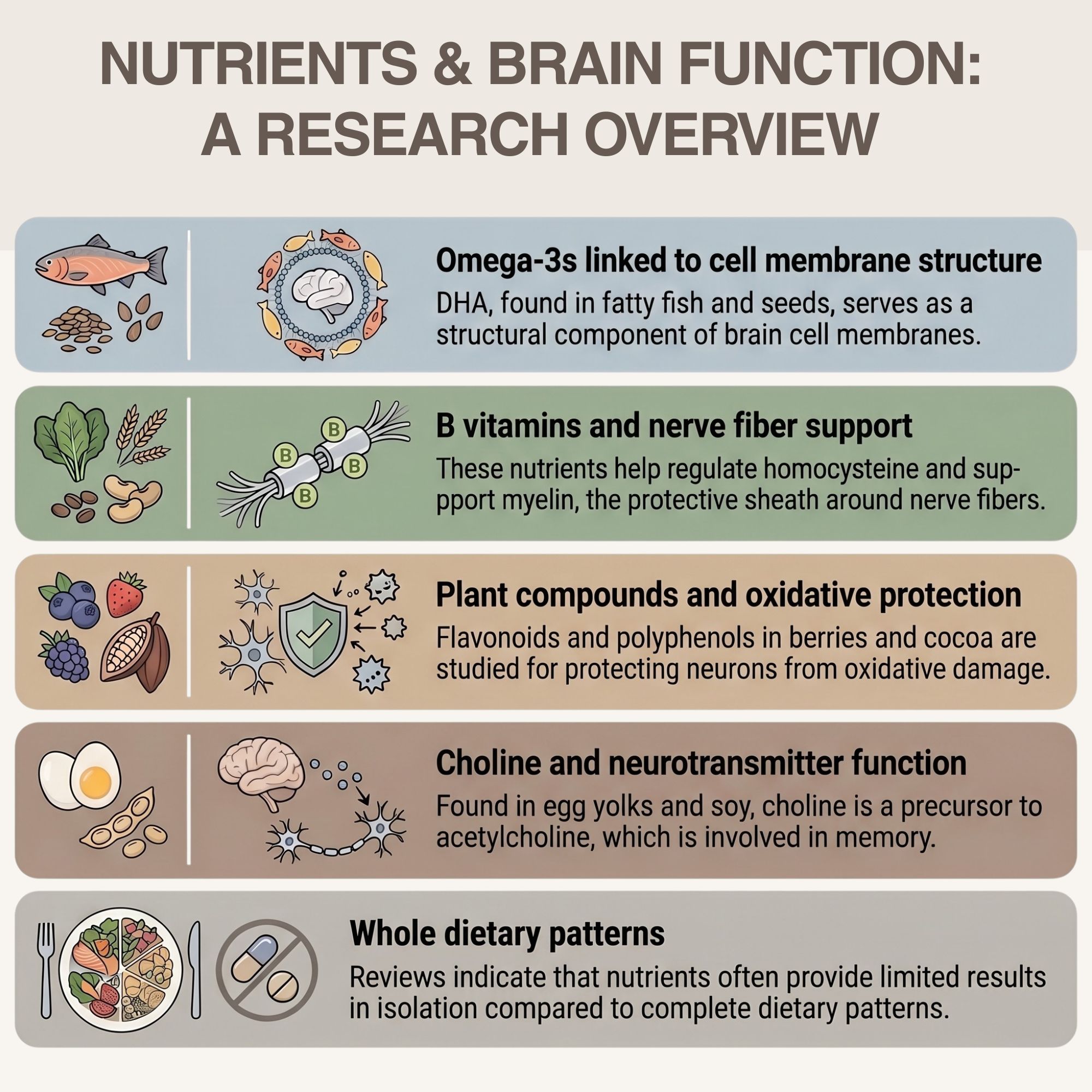
- Omega-3 fatty acids (DHA and EPA) – found in fatty fish, walnuts, flaxseed, and chia. DHA is a structural component of brain cell membranes. Low intake is associated with faster cognitive decline, particularly when combined with low B-vitamin status [11].
- B vitamins (folate, B6, B12) – found in leafy greens, legumes, eggs, meat, and fish. B vitamins regulate homocysteine (an amino acid that at elevated levels is linked to brain atrophy) and support myelin, the protective sheath around nerve fibres [12,13].
- Flavonoids and polyphenols – found in berries, cocoa, green tea, and colourful vegetables. These plant compounds help protect neurons from oxidative damage (harm caused by unstable molecules called free radicals) and support communication between brain cells [14].
- Choline – found in egg yolks, meat, and soy products. Choline is a precursor to acetylcholine, a neurotransmitter essential for memory and learning [15].
- Vitamin D – found in fatty fish, egg yolks, and fortified foods. Low vitamin D levels are associated with poorer cognitive outcomes, though the direction of causation remains under investigation [16].
- Magnesium – found in nuts, seeds, whole grains, and leafy greens. Involved in synaptic plasticity, meaning the brain’s capacity to strengthen or weaken connections based on activity [17].
Iron and zinc – found in red meat, lentils, shellfish, and whole grains. Both support oxygen transport to the brain and are involved in synaptic function and attention [18].
Good to know: Nutrients rarely act alone. Reviews consistently find that whole dietary patterns outperform individual nutrients because the compounds in food interact and reinforce each other [16].
Foods good for brain function work largely through specific nutrients. Here are the most evidence-supported, with their mechanisms and main dietary sources.
- Omega-3 fatty acids (DHA and EPA) – found in fatty fish, walnuts, flaxseed, and chia. DHA is a structural component of brain cell membranes. Low intake is associated with faster cognitive decline, particularly when combined with low B-vitamin status [11].
- B vitamins (folate, B6, B12) – found in leafy greens, legumes, eggs, meat, and fish. B vitamins regulate homocysteine (an amino acid that at elevated levels is linked to brain atrophy) and support myelin, the protective sheath around nerve fibres [12,13].
- Flavonoids and polyphenols – found in berries, cocoa, green tea, and colourful vegetables. These plant compounds help protect neurons from oxidative damage (harm caused by unstable molecules called free radicals) and support communication between brain cells [14].
- Choline – found in egg yolks, meat, and soy products. Choline is a precursor to acetylcholine, a neurotransmitter essential for memory and learning [15].
- Vitamin D – found in fatty fish, egg yolks, and fortified foods. Low vitamin D levels are associated with poorer cognitive outcomes, though the direction of causation remains under investigation [16].
- Magnesium – found in nuts, seeds, whole grains, and leafy greens. Involved in synaptic plasticity, meaning the brain’s capacity to strengthen or weaken connections based on activity [17].
Iron and zinc – found in red meat, lentils, shellfish, and whole grains. Both support oxygen transport to the brain and are involved in synaptic function and attention [18].
Specific Foods Good for Brain Function: What Doses Actually Work
When it comes to foods to eat for brain power, human trials point most consistently to walnuts, berries, and fatty fish. The question is not just which foods, but how much and for how long.
Walnuts
- Among all nuts, walnuts have the strongest evidence as a brain food, attributed to their ALA omega-3 content and high polyphenol levels [19].
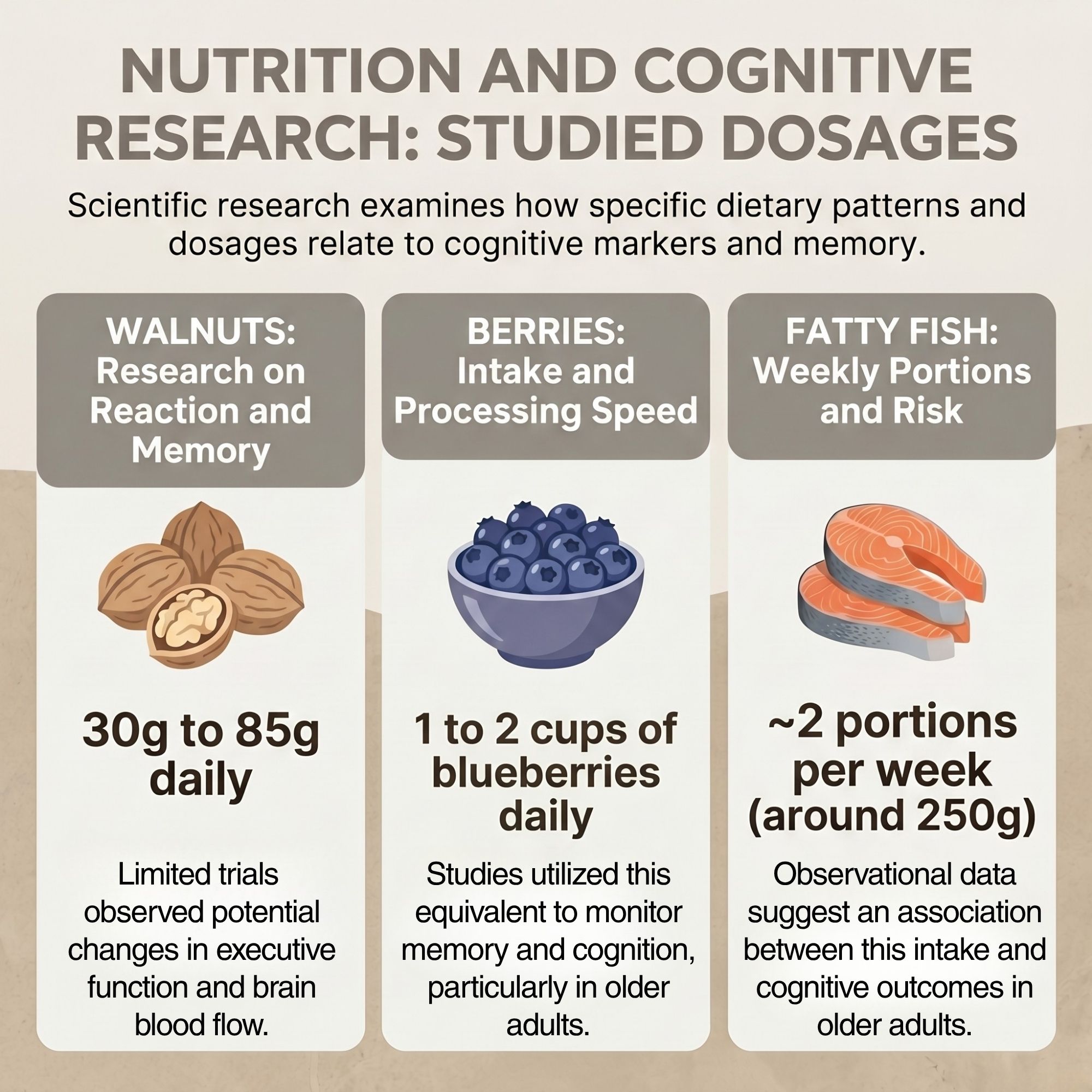
- Trials used doses of 30 to 85 g per day (roughly one to three small handfuls). A single 50 g walnut breakfast improved executive-function reaction times across a six-hour period in young adults [20,21].
- A 16-week trial using 60 g per day of mixed nuts improved brain blood flow and both visuospatial and verbal memory in older adults [22].
Berries
- Doses in trials ranged from the equivalent of 1 to 2 cups of blueberries daily, or concentrated products, with improvements seen in global cognition, memory, and processing speed [23,24].
- Effects are attributed primarily to anthocyanins (a class of flavonoid plant pigment) and are more pronounced in older adults or those with early memory concerns [14].
Fatty fish
- A food-based trial adding fatty fish weekly, providing approximately 2.2 g of omega-3 per day, improved global cognition over 12 weeks in tested adults [25].
- Meta-analyses suggest that up to two portions (approximately 250 g) of fish per week is associated with reduced dementia risk, with benefits plateauing above this amount [26,27].
Plasmalogens: The Brain Lipids Most People Have Never Heard Of
Recommended product
How Fast Can Diet Change Your Brain?
The timeline depends on what kind of change you are measuring.
| Time frame | What may change | Evidence |
| Next day | Processing speed, executive function | Higher Mediterranean-style eating on one day predicted better cognition the following day in a diary study of 217 adults [33]. |
| Weeks to months | Working memory, attention, some memory measures | Probiotic and food interventions over 12 to 36 weeks showed improvements in specific cognitive domains in several trials [34,35]. |
| Years | Protection against cognitive decline | The FINGER trial showed improved global cognition after two years of dietary change; long-term adherence to Mediterranean or DASH diets was linked to slower decline over six years [36,37]. |
The short-term effects are real but modest. The case for a brain-healthy diet is ultimately a long-term one.
How to Build a Brain-Healthy Diet: A Practical Starting Point
The foods good for brain health identified by research cluster around a recognisable pattern. Translating that into daily habits does not require a rigid protocol.
Add regularly:
- Oily fish (salmon, sardines, mackerel) at least twice a week
- A small handful of walnuts daily (30 to 60 g)
- Berries several times a week, fresh or frozen
- Leafy greens daily (spinach, kale, rocket)
- Olive oil as the primary cooking and dressing fat
- Legumes (lentils, chickpeas, beans) three or more times a week
Limit:
- Processed meats and refined grain products
- Added sugars and sugar-sweetened drinks
- Foods high in saturated fat
Eating fatty fish alongside leafy greens, eggs, and legumes naturally covers the most important nutritional bases. No single food carries the whole load. The pattern does.
Key Takeaways
- Brain volume begins declining from the mid-thirties, with executive functions affected from as early as the twenties.
- The strongest evidence for brain health comes from overall dietary patterns: Mediterranean, MIND, and DASH diets are consistently associated with slower cognitive decline and lower dementia risk.
- Among specific foods, berries, walnuts, and fatty fish have the best trial support. Olive oil and leafy greens are core components of all protective patterns.
- B12 matters only when there is an actual deficiency. Supplementing without deficiency does not enhance cognition in healthy adults.
- Plasmalogens, a class of brain membrane fats, decline significantly in ageing and dementia, and are an emerging focus of nutritional research.
- Some dietary effects on speed and executive function can appear within a day. Meaningful protection against cognitive decline builds over years.
Frequently Asked Questions
What foods are good for brain health?
The most consistently supported foods to help brain function are berries, walnuts, fatty fish, leafy greens, and olive oil. These are the core components, which show the strongest evidence across large human studies.
How much food good for brain health do I need to eat to see a benefit?
Trial doses that produced measurable effects include roughly 30 to 60 g of walnuts daily, the equivalent of 1 to 2 cups of blueberries, and at least two portions of fatty fish per week. Effects on processing speed can appear within a day, but meaningful protection against cognitive decline builds over years of consistent eating.
Are walnuts really a brain food?
Among nuts, walnuts have the most consistent evidence. A single 50 g walnut breakfast improved executive-function reaction times over a six-hour period in young adults. Their ALA omega-3 content and high polyphenol levels are considered the main contributing factors.
Does vitamin B12 help brain function?
B12 is essential for brain health, but only when levels are low. Supplementing B12 without an existing deficiency does not improve cognition in healthy adults. If you are concerned about your B12 status, a blood test is the appropriate starting point.
What are plasmalogens and why do they matter for the brain?
Plasmalogens are a class of fats found in brain cell membranes that play a role in membrane flexibility and protection against oxidative damage. Their levels decline with age and drop substantially in Alzheimer’s disease. For a detailed overview, see Plasmalogens and Dementia: What Does the Research Actually Show?
How quickly can diet change brain function?
Some effects on processing speed and executive function can appear the following day after higher-quality eating. Broader cognitive benefits from dietary interventions typically emerge over weeks to months, while protection against long-term cognitive decline requires years of sustained dietary patterns.