
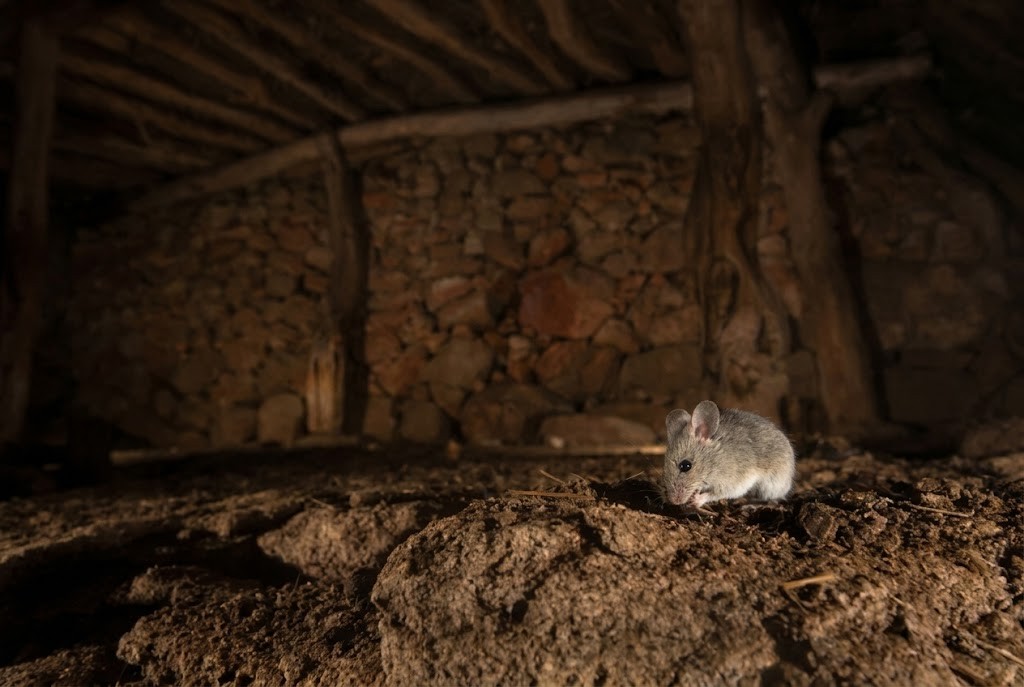
Spring 1951. The Korean Peninsula. Thousands of United Nations soldiers began experiencing what looked like an ordinary bout of influenza: fever, muscle pain, fatigue. Within days, their kidneys were failing. Hundreds died, and their commanders had no idea what was killing them. The enemy was not hiding in the trenches, but in mouse droppings scattered across the fields where the soldiers slept, ate, and dug their foxholes.
During the Korean War, more than 3,000 UN soldiers fell ill with a mysterious disease. The US Army launched an intensive research programme. It would take nearly thirty years before scientists identified the culprit in 1978: a new virus, named after the Hantaan River running along the demarcation line between North and South Korea [1].
Hantavirus was not new. It had simply gone undetected for a very long time.
A Virus as Old as Civilisation, Discovered in the Modern Era
What Is Hantavirus?
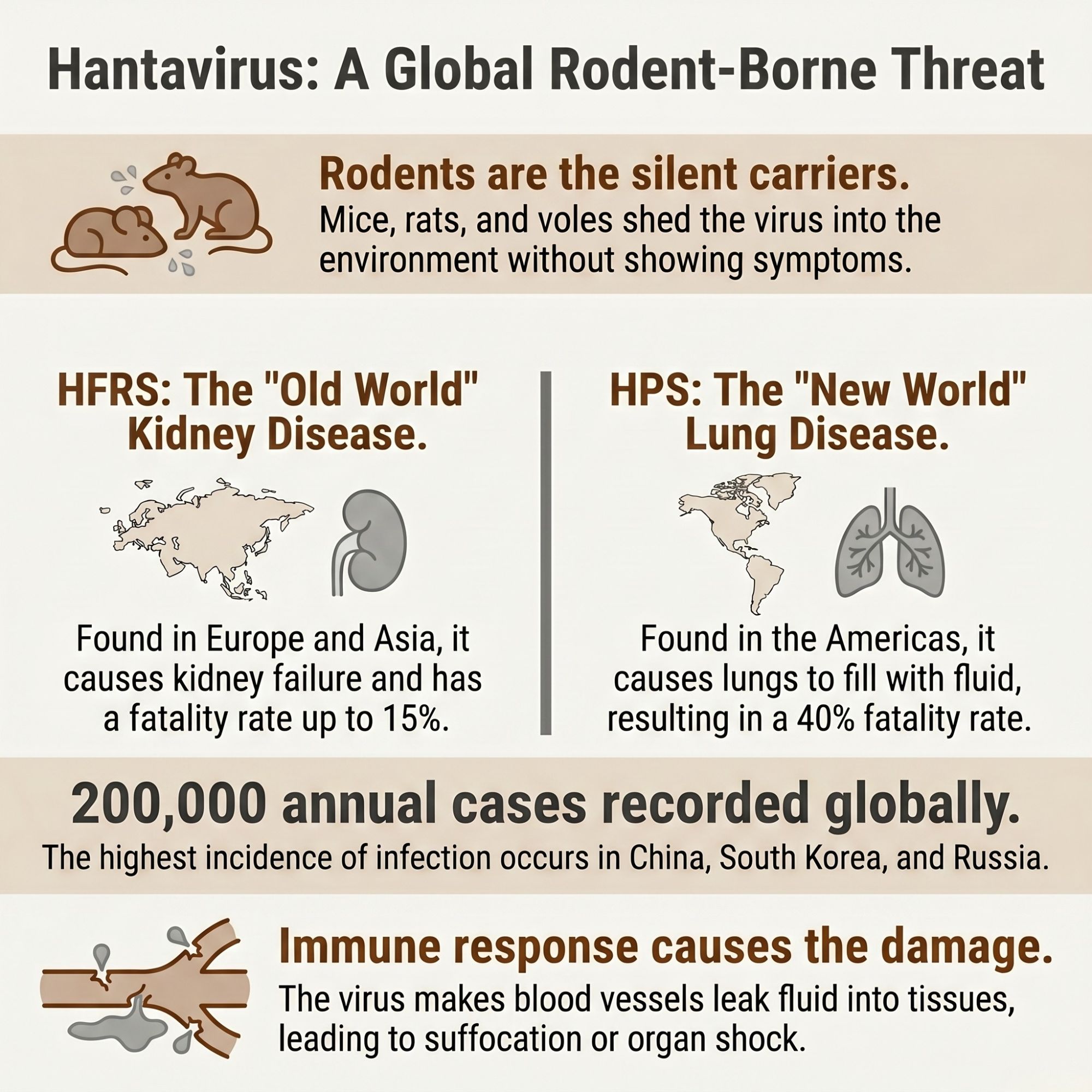
Hantavirus is a family of RNA viruses carried mainly by small rodents such as mice, rats, and voles. In their bodies, the virus circulates persistently and without causing illness. The rodents do not become sick; they simply shed the virus into the environment continuously. For rodents, hantavirus is an unobtrusive co-inhabitant. For humans, it can be lethal.
In humans, hantaviruses cause two distinctly different diseases, differing in geography, affected organs, and severity.
- Organ affected: the kidneys, which may fail completely.
- Clinical course: fever, pain, haemorrhagic manifestations, and in severe cases, shock.
- Severity: depends on the virus type. The European Puumala virus is usually mild (case fatality rate below 1%), the Balkan Dobrava-Belgrade is more serious (up to 10–12%), and the Asian Hantaan virus the most severe (5–15%).
- Organ affected: the lungs. The virus damages blood vessels so that fluid leaks into the lung tissue, and the patient suffocates despite normal cardiac function.
- Clinical course: begins as influenza-like illness, and within 4 to 10 days may progress to respiratory failure and cardiogenic shock.
Both forms share a common underlying mechanism. The virus infects endothelial cells lining blood vessels throughout the body, increases their permeability, and triggers fluid leakage into surrounding tissues. It is not direct cell destruction that ultimately kills the patient, but a dysregulated immune response [6].
Sin Nombre Virus and the Four Corners Outbreak
May 1993, south-western United States. In the region where the states of Arizona, New Mexico, Colorado, and Utah converge, young, healthy people, most of them Native Americans, began dying from a mysterious respiratory failure. Symptoms progressed with alarming speed: after several days of influenza-like illness, massive pulmonary oedema and death followed. The initial case fatality rate in this group reached 70 to 76% [7].
Investigators quickly identified the cause. Exceptionally heavy rainfall driven by El Niño in 1991 to 1992 had triggered an explosion of vegetation and insects across the region. Populations of the deer mouse (Peromyscus maniculatus), the primary reservoir host, increased tenfold to twentyfold at some monitored sites.
When drought arrived, the mice moved into human dwellings. People who were cleaning out barns, turning hay, or working in dusty spaces contaminated with mouse droppings were inhaling aerosols from a new, previously unknown virus. It was named Sin Nombre, meaning the virus with no name [8].
This case revealed something unsettling: hantavirus does not need a war. A mouse and a change in weather are enough.
Andes Virus and Human to Human Transmission
Most hantaviruses do not spread between people. Humans represent what is known as a dead-end host: they become infected and fall ill, but do not transmit the virus further. This is due to biological barriers. The virus produces very few infectious particles in the human respiratory tract, and human saliva contains IgA antibodies that block its replication.
Andes virus is the only known hantavirus for which this does not hold true. It is this virus that was responsible for the outbreak aboard a cruise ship in 2026, which raised legitimate public concern.
This virus can be transmitted from person to person, but the data show that the risk depends heavily on the type of contact. It is highest during prolonged, close physical contact with an infected individual [9].
Europeans are additionally in a specific situation. Andes virus does not occur naturally in Europe. Its natural reservoir, the long-tailed pygmy rice rat (Oligoryzomys longicaudatus), is endemic exclusively to Argentina and Chile. The European hantaviruses Puumala and Dobrava do not transmit between people at all. The real risk for the average European therefore lies not in person-to-person transmission, but in contact with rodents in natural environments or enclosed spaces.
The risk of infection rises when visiting forests and upland areas with rodent populations, when cleaning long-unoccupied spaces such as garden sheds, barns, or cellars, and when working with timber or soil. Forest workers and farmers, for instance, have a twofold to threefold higher risk of infection compared with the general population [10].
Immunity, Protection, and What Is Still Missing
It is worth considering what happens when hantavirus enters the body of a person with a robust immune response. The majority of infections pass unnoticed. A global meta-analysis [11] of 110 studies found that nearly 3% of the world’s population carries antibodies against hantaviruses without ever knowing they were infected. Finnish data [10] suggest that up to 70 to 80% of all those infected never seek medical attention.
A silent infection does not mean a defenceless one. Research shows that even without symptoms, the immune system produces neutralising antibodies comparable to those found in patients who have recovered from severe disease [12].
The immune system therefore determines whether an infection passes unnoticed or develops into serious illness. An excessive inflammatory response, where immunity reacts too strongly, damages blood vessel walls more than the virus itself. Protection is therefore not simply a matter of whether the body detects the virus, but of how balanced a response it mounts.
Recommended products




No hantavirus vaccine is currently available in Europe or the United States. Inactivated vaccines exist in China and South Korea, but their efficacy remains uncertain [13].
Practical protection therefore rests on straightforward measures:
- When cleaning enclosed spaces, never sweep dust dry. Dampen surfaces with a bleach solution (1 part bleach to 9 parts water), leave it to act for 10 minutes, and use an FFP2 respirator.
- In forests and outdoor environments, avoid direct contact with rodents, their burrows, and their droppings.
- Store food and waste in sealed containers that prevent rodent access.
- When in contact with an infected person (Andes virus), avoid close physical contact and sharing drinks or utensils.