

Not all plasmalogen-rich foods help your brain in the same way. The richest source by weight is not necessarily the one your brain actually uses. This article looks at which everyday foods make a real difference, how much they provide, and whether supplements add anything that food cannot.
Quick Summary
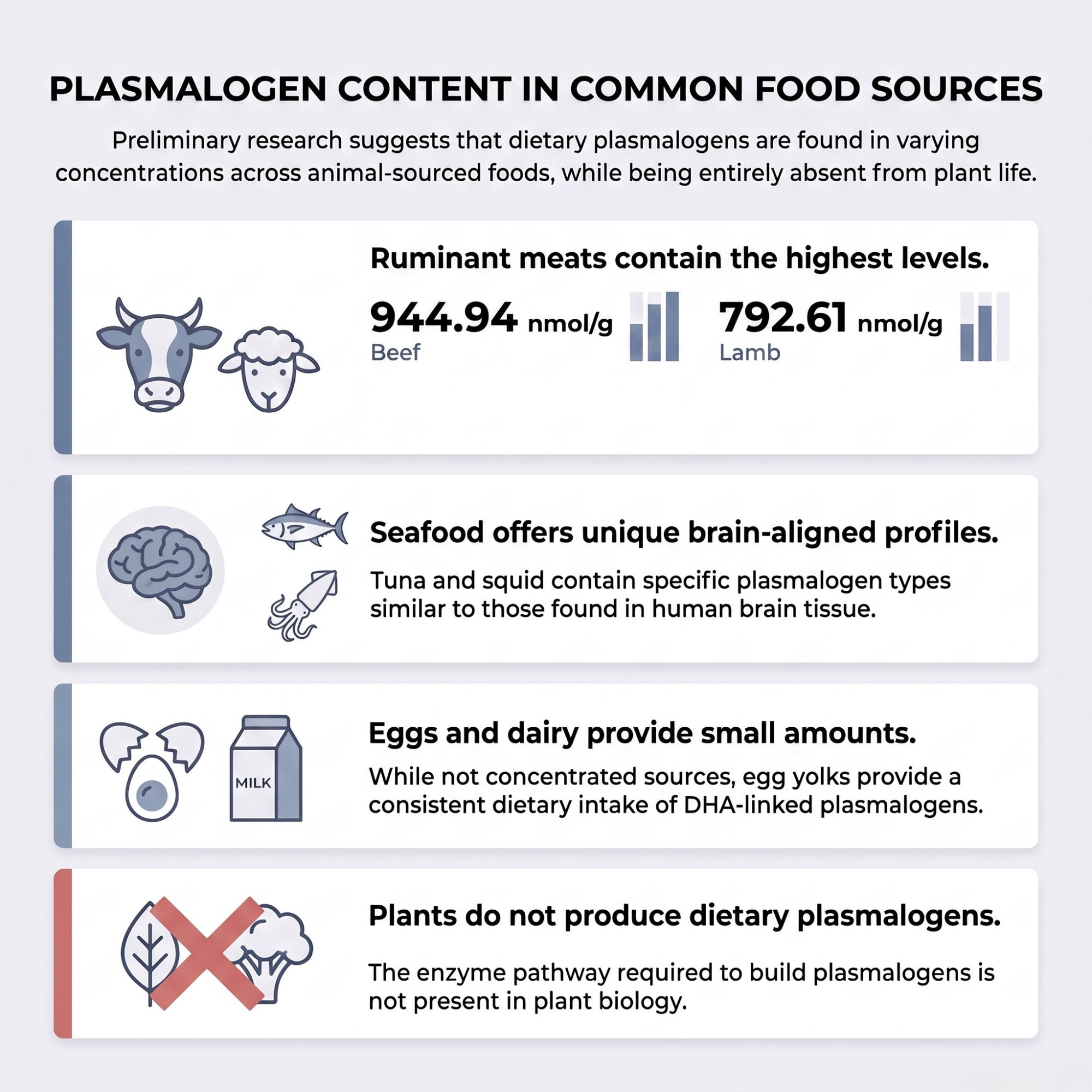
- Beef is the richest source of plasmalogens overall, with lamb close behind. Tuna and squid trail well behind both.
- Squid and other seafood plasmalogens are built mainly on EPA and DHA, the type most directly tied to brain function, while beef and lamb plasmalogens are not.
- Plants never evolved the enzyme pathway needed to make plasmalogens. Vegans have no dietary source at all, while vegetarians can get small amounts from eggs and dairy.
What Foods Contain Plasmalogens?
Plasmalogens are found almost entirely in animal foods. Meat, seafood, and egg yolk are the three main plasmalogen food sources, and each contributes a different amount and type [1].
No plant food contains measurable plasmalogens. The biological pathway that builds them exists only in animals and a small number of bacteria, never in plants or fungi [2,3]. This means the usual plant-forward eating patterns recommended for general health contribute little to plasmalogen intake specifically.
What are plasmalogens? Plasmalogens are a distinct class of fat that makes up around 15–20% of the phospholipids in human cell membranes. They are especially concentrated in the brain, heart, and immune cells, where they support nerve cell communication and act as natural antioxidants that protect tissue from oxidative stress. They also help carry omega-3 fats such as DHA to the tissues that rely on them most. For a complete explanation, see What Are Plasmalogens? Definition, Function, and Health Benefits.
Plasmalogen Food Sources: Which Foods Have the Highest Levels?
Among common foods, beef contains the most plasmalogen by weight. The table below sets out measured plasmalogen levels, in nanomoles per gram of wet tissue, from a laboratory analysis of everyday foodstuffs [1].
Food | Plasmalogen content (nmol/g wet weight) |
Beef | 944.94 (highest) |
Lamb | 792.61 |
Tuna | 399.75 |
Squid | 384.76 |
Pork | 530.83 |
Octopus | 208.88 |
Salmon | 95.53 |
Scallop | 10.00 (lowest) |
- Livestock meats consistently contain more plasmalogen than fish or shellfish on a like-for-like weight basis [1].
- Beef and lamb sit clearly ahead of pork among these meats, largely because ruminant animals such as cattle and sheep tend to carry more plasmalogen in their tissue than other livestock.
- Chicken was not separately quantified in this dataset, so it cannot be ranked against the meats listed above.
Worth knowing: More plasmalogen is not automatically better. The type of plasmalogen matters as much as the amount, and this is where seafood becomes relevant. Fish and shellfish contain less in total, but a meaningfully different profile, more closely aligned with the type found in brain tissue.
Seafood Sources of Plasmalogens
Seafood contains less total plasmalogen than meat, but it is unusually rich in the specific type most associated with brain tissue.
- Tuna and squid rank among the richest seafood sources, each holding levels not far behind pork, and squid stands out among mollusks in particular.
- Octopus is also a strong option, and its plasmalogens are heavily loaded with omega-3 fats rather than the fats typically found in land animals.
- Mussels and ascidian tissue stand out for their concentration of ethanolamine plasmalogen, the same type that dominates in the brain, though these are reported in different units to muscle tissue and are not directly comparable to the table above [4].
- Scallops come in lowest among all the sources listed here, despite being the ingredient most often used in plasmalogen supplement research.
That last point is worth remembering. How can scallops be one of the lowest natural options for plasmalogen yet remain the preferred ingredient in supplement research? Much of the answer lies in scallop processing itself: the industry generates large volumes of leftover internal organs from routine processing, and these otherwise discarded tissues carry plasmalogen levels comparable to the edible muscle, giving manufacturers a practical raw material at scale.
Explore more: If you are interested in a wider overview of brain-supportive foods such as walnuts, berries, and oily fish, see also our article Foods Good for Brain Health: Science, Patterns and Practical Answers.

Dietary Plasmalogen from Eggs and Dairy
Egg yolk provides a small but well-documented quantity of dietary plasmalogen, around 0.3 mg per yolk, mostly the DHA-linked type also found in brain tissue [5].
Egg yolk is not a concentrated source in the way beef or squid are, but it is a consistent, easy addition to a normal diet, and it adds up over repeated meals through the week.
Dairy products contain plasmalogen too, though at levels far below meat and seafood. Milk is reported in micrograms per millilitre, a different unit from the nanomoles per gram used above, which makes direct comparison difficult [6]. Among dairy products, cheese tends to retain more plasmalogen than butter, since butter-making strips away much of the membrane material that carries it.
Are there vegetarian sources of plasmalogens?
No, plants do not make plasmalogens, so a vegetarian or vegan diet cannot supply them directly [3]. This is a straightforward biological gap rather than a matter of choosing the “right” plant foods or eating more of them.
The enzyme pathway that builds plasmalogens simply never evolved in plants, so no volume of leafy greens, legumes, or plant oils will change that. Some soil and gut bacteria can produce small traces of plasmalogen, but this is not a realistic or practical dietary route for humans [2].
Vegans, who avoid all animal products, have no dietary route to plasmalogen at all. Vegetarians who include eggs and dairy can get the small, steady amounts described above from those foods, though nowhere near the levels found in meat or seafood. For strict vegans, a purified precursor supplement is the only route to plasmalogen intake without animal foods.
How Cooking Affects a Plasmalogen Diet
- Boiling causes only minimal loss, even after 30 minutes of cooking time.
- Roasting and frying cause more significant loss, worsened by higher heat and longer cooking time.
- Frying is the most damaging method overall, partly because the outer surface of the meat loses more plasmalogen than the inside, likely due to direct heat exposure.
- Freezing and repeated freeze-thaw cycles also reduce plasmalogen content over time, particularly in fish and other seafood.
- Coating meat in batter before frying measurably protects plasmalogens from this heat-driven loss, giving anyone who does fry a practical way to limit the damage.
Are Plasmalogen Supplements Worth It?
Food alone provides far less plasmalogen than the doses used in research. A single egg yolk contains around 0.3 mg, while human trials of plasmalogen supplements have used doses ranging from 1 mg up to several thousand milligrams per day [9,10].
This is where the scallop point from earlier becomes relevant. Scallops are one of the lowest natural plasmalogen sources measured, yet scallop-derived extract is the ingredient most commonly used in clinical research. That combination is only possible because the extract used in trials is concentrated far beyond anything a normal seafood portion would provide.
Interesting fact: Reaching a research dose of 50 mg per kilogram of body weight would require a 70-kilogram person to eat around 460 kilograms of scallops [11].
Digestion also gets in the way. Most of the plasmalogen in a meal is broken down in the gut before it ever reaches the bloodstream intact, so only a small fraction of what you eat survives the journey whole [12]. Supplements provide far more plasmalogen than a normal food portion, which is why research trials use them rather than whole food to study higher plasmalogen intake.
None of this means food-based plasmalogen intake is pointless. Diet remains the main source of plasmalogen and supports general nutrition regardless of any specific plasmalogen goal. For anyone getting too little dietary plasmalogen this way, supplements such as Cogni8 are formulated specifically to raise plasmalogen intake beyond what food realistically provides on its own. As with any supplement, it makes most sense as an addition to a varied diet, not a replacement for one.
Safety data from clinical trials generally describe good tolerability, though the overall evidence base remains at an early stage. For a fuller look at safety and the causes of deficiency, see Plasmalogen Deficiency: Signs, Causes and How to Address It.
Key Takeaways: Best Plasmalogen Foods to Add to Your Diet
The food richest in plasmalogen is not automatically the one that matters most for the brain, since total content and biological profile are separate questions. Beef and lamb top the table but carry mostly a different plasmalogen type to the one most abundant in brain tissue, while squid, tuna, and octopus lean toward that brain-relevant type in smaller total quantities.
- Beef and lamb for the highest content among meats.
- Squid, tuna, and octopus for the marine, omega-3-linked type.
- Mussels as a further seafood option with the same marine profile.
- Egg yolk as a small, repeatable weekly contribution.
No plant food supplies plasmalogen, which leaves vegans without a dietary source and vegetarians reliant on eggs and dairy for modest quantities. Cooking method matters almost as much as food choice: gentle heat keeps far more plasmalogen intact than frying does.
There is no need to eat unusually large quantities of any single food, and no single ingredient covers every type on its own. A diet that regularly includes meat, seafood, and eggs will naturally provide more plasmalogen than one built mainly around plant foods, simply because of where these fats occur in nature.
Frequently Asked Questions
What foods is plasmalogen found in?
Plasmalogen is found mainly in meat, seafood, and egg yolk. Beef contains the highest levels among common meats, while squid, tuna, and mussels are among the richest seafood sources. For a broader look at where plasmalogens sit in the body, see What Are Plasmalogens? Definition, Function, and Health Benefits.
What is plasmalogen made up of?
A plasmalogen is a type of fat molecule built on a glycerol backbone, with one chain attached by an unusual vinyl-ether bond rather than the more common bond found in ordinary fats. This structural difference is what makes plasmalogens behave differently from other membrane fats. A full explanation is available in What Are Plasmalogens? Definition, Function, and Health Benefits.
How to get plasmalogens?
The main way to get plasmalogens is through diet, particularly meat, seafood, and egg yolk. Because food provides much smaller amounts than research doses, some people also turn to plasmalogen supplements for a more consistent intake.
Can plasmalogen levels be increased?
Yes, plasmalogen levels can be raised through diet and, more substantially, through supplements. Food alone tends to produce only modest changes, while supplement forms have shown larger increases in clinical studies. For more detail, see Plasmalogen Deficiency: Signs, Causes and How to Address It.
What diseases are linked to plasmalogen deficiency?
Lower plasmalogen levels are consistently reported in Alzheimer’s disease and Parkinson’s disease, alongside a small number of rare inherited disorders. A detailed breakdown of these links is covered in Plasmalogen Deficiency: Signs, Causes and How to Address It and Plasmalogens and Dementia: What Does the Research Actually Show?
What are the benefits of increasing plasmalogen intake?
Research links higher plasmalogen levels to better outcomes in some observational studies, though this does not prove that increasing intake directly causes those benefits. The clearest evidence so far relates to cognitive function in early research trials, explored in more depth in Plasmalogens and Dementia: What Does the Research Actually Show?