
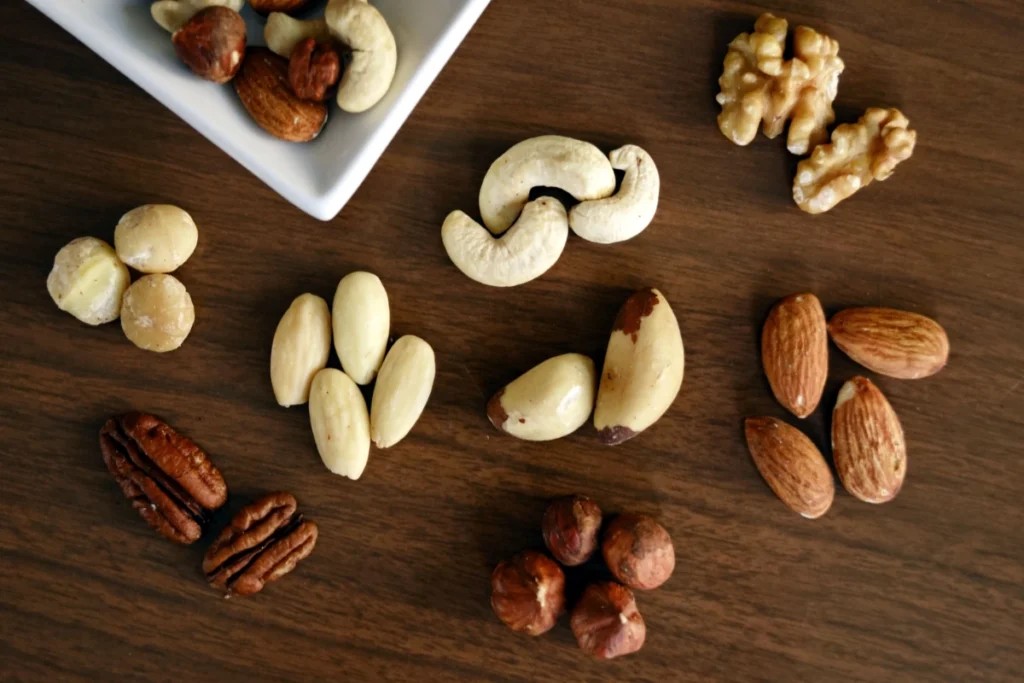
Nuts have picked up a reputation as brain food almost by default, repeated so often that few people stop to check where it comes from. The strongest studies available still cannot prove that nuts on their own protect memory or slow cognitive decline. So how much of that is actually true?
Quick summary
- Randomised trials on nuts and cognition remain limited and inconsistent. The clearest signals come from long-term observational studies in older adults, not controlled experiments.
- Walnuts have the most consistent supporting evidence among nut types, though pistachios show early promise.
- Portion size, freshness and storage affect the value of nuts as much as which type you choose.
Do Nuts Really Work as Brain Food?
How Strong Is the Evidence, Really?
| Study type | What it found | Evidence strength |
| RCT meta-analysis (5 trials, 928 adults) [1] | No significant effect on cognition scores | Weak |
| Cohort study, a group tracked over time (6,630 older adults) [2] | Smaller cognitive decline with high intake | Moderate |
| Cross-sectional study, a one-time snapshot of people’s habits [3] | Positive associations, but prone to recall bias | Moderate |
Three verdicts on the same question. Which one should you believe? Each type of study looks at nut eaters differently, and each comes with its own blind spot:
- Cross-sectional studies rely on people recalling what they used to eat. Memory slips, but there is a subtler issue too: people with sharper minds may simply live healthier lives that happen to include more nuts, not the other way around.
- Cohort studies follow the same people for years, which carries more weight, but the link fades once heart health and other lifestyle factors are taken into account [2]. Nuts may be riding along with an overall healthier routine, not driving it.
- Randomised trials often run for months rather than years, which may be too short a window to catch a change in thinking that builds up slowly.
Put together, that is why the studies pull in different directions: nobody can yet prove the nuts deserve the credit, but the pattern keeps showing up study after study, which is reason enough to keep eating them.
Which Nuts Are Good for Brain and Memory?
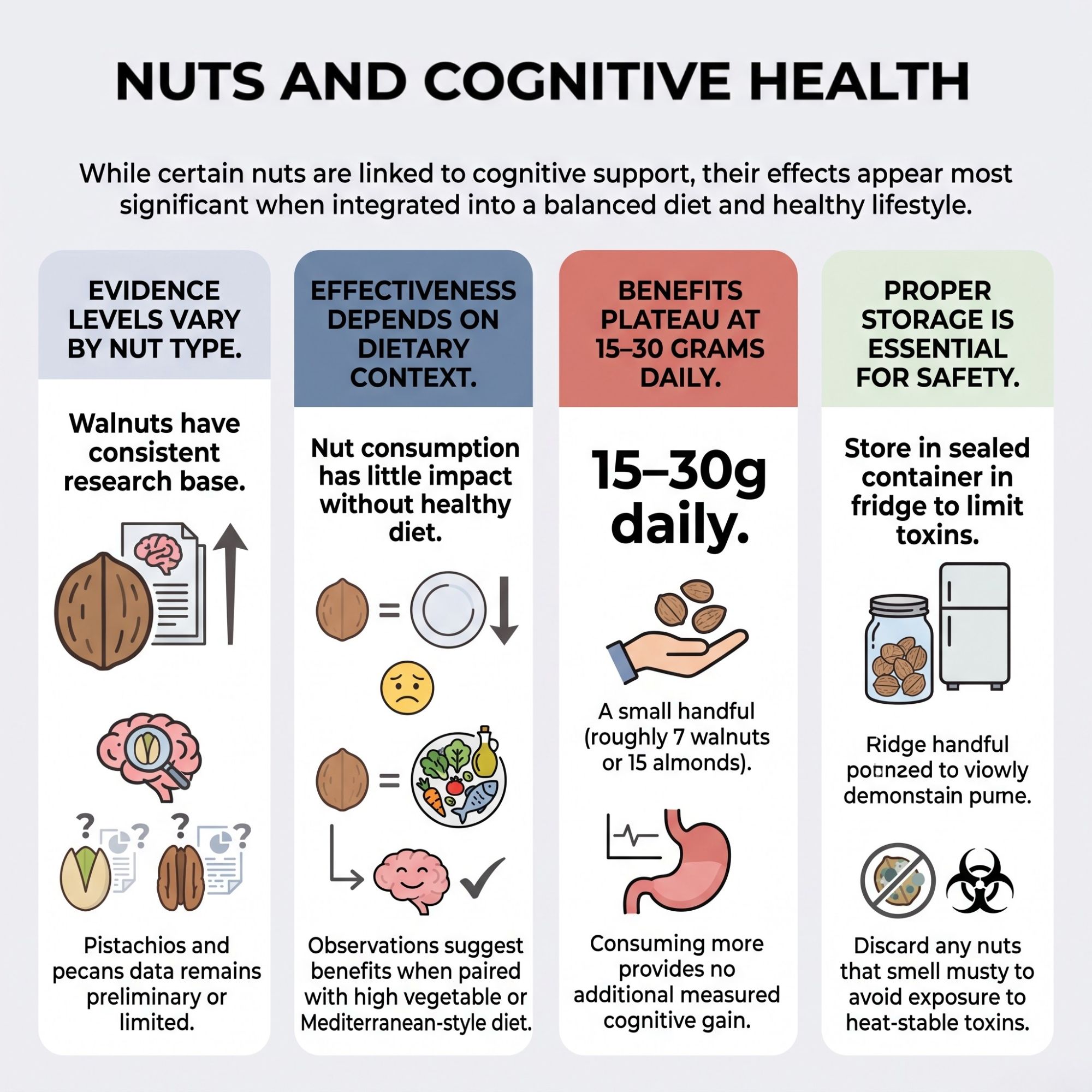
Walnuts have the most consistent evidence for brain and memory support among nut types [4]. The reason, however, is that they have been studied more, not that their biology is uniquely powerful.
Pistachios are the nut to watch: laboratory work looks encouraging and a small trial in overweight adults found short-term gains in attention and decision-making, but no trial has yet tested pistachios specifically in older adults at risk of decline, and one is currently underway [5]. The table below gives a quick overview of each nut and its strongest evidence.
| Nut | Strongest point | Evidence base |
| Walnut | Highest phenolic content among dry fruits, best omega-3 to omega-6 balance | Strongest, six human studies [4] |
| Almond | Highest soluble protein, vitamin E | Moderate, mostly animal data [6] |
| Pistachio | Improved attention in a small pilot trial | Early, one uncontrolled human study [7] |
| Pecan | Highest antioxidant capacity | Preliminary [8,9] |
| Brazil nut | Selenium-linked antioxidant activity | Preliminary [8] |
Why Nuts Alone Are Not Enough
Here’s the catch nobody mentions: people who eat a lot of nuts also tend to do a dozen other things right, more vegetables, more movement, more years in school. Once you account for that, confidence in a clean nut effect drops fast.
Among people who rarely touched vegetables, researchers found the tie between nuts and sharper thinking disappeared completely [10]. Scientists also tested nuts inside a full Mediterranean-style way of eating: on their own, nuts changed nothing, the benefit only showed up as part of that wider approach [2].
How Nuts May Support the Brain: Proposed Mechanisms
Worth knowing: Memory and mental sharpness often fade with age, and part of that may trace back to a brain lipid called a plasmalogen. Falling plasmalogen levels have been linked to cognitive decline and memory problems, and these lipids also help build the myelin sheath that insulates nerve fibres. To find out more, read What Are Plasmalogens? Definition, Function, and Health Benefits and Plasmalogen-Rich Foods: Natural Dietary Sources.
How Many Nuts a Day Is Enough?
Roasting, Storage and Quality: What Actually Changes Nuts
Key Takeaways
Nuts are a reasonable, evidence-supported addition to the diet, but the label brain food promises more certainty than the research delivers. Walnuts currently have the strongest track record, pistachios are an emerging contender, and the benefit appears tied to overall diet quality rather than to any single nut acting alone. A modest daily portion, stored properly and eaten as part of a varied diet, is where the evidence actually points.
Frequently Asked Questions
Which nuts are best for brain health?
What are the benefits of walnuts for brain function?
How do almonds compare to other nuts for mental clarity?
How much of a daily nut intake supports brain health?
Can eating nuts help prevent cognitive decline?
Which nuts contain the highest levels of plasmalogens?
No nut has been identified as the top source, largely because nut tissue itself has not been measured for plasmalogen content. For foods with measured plasmalogen content, see Plasmalogen-Rich Foods: Natural Dietary Sources. For a supplement route, Cogni8 supplies plasmalogens directly rather than through precursor compounds.